

How to Write Product Descriptions Faster Without Losing Quality
You finally get your products online… then realize you have 150 pages left to write.
Writing one strong description is easy. Writing hundreds is where most small and medium-sized businesses stall.
Learning how to write product descriptions quickly—without turning them into bland, copy-paste text—is what separates stores that sell from those that just sit online.
In this guide, you’ll learn a repeatable, efficient workflow for product description writing that keeps quality high, supports SEO, and actually helps customers decide to buy.
Why Speed and Quality Both Matter in Product Descriptions
For SMBs moving into eCommerce, time is limited and margins are tight:
- Slow writing delays product launches and cash flow.
- Rushed writing leads to vague, low-converting product descriptions.
- Poor copy means more questions, more returns, and fewer sales.
You need a system that lets you produce high-converting product descriptions at scale—fast—while still sounding human, helpful, and on-brand.
What You’ll Learn in This Tutorial
By the end, you’ll know how to:
- Set up tools and templates that let you write product descriptions quickly without losing quality
- Batch research so you’re not hunting for info for every product
- Use real customer language to improve eCommerce product descriptions
- Add SEO without slowing everything down
- Build an efficient workflow for product description copywriting your team can follow
Prerequisites (Tools, Knowledge, Requirements)
Before you speed up, put a few basics in place so you’re not fixing issues later.
Clarifying Your Brand Voice and Audience
You can’t write clear, consistent copy if you’re not sure who’s talking—or to whom.
Answer briefly:
- Who is your ideal customer? (age, role, main problem)
- How do you want to sound? (friendly, expert, playful, luxury, no-nonsense)
- What do customers care about most? (price, durability, style, speed, safety, etc.)
Write 3–5 sample sentences in your brand voice and store them in a simple style guide for anyone who writes ecommerce product descriptions.
Essential Tools for Writing Product Descriptions Faster
You don’t need expensive software. Start lean.
AI Writing Assistants and Templates
Use AI tools (like ChatGPT or similar) to:
- Turn bullet-point details into clean first drafts
- Rewrite in your brand voice
- Generate variations for A/B testing
Combine this with a reusable description template (more on that in Step 1).
Keyword and SEO Research Tools
For SEO-friendly product descriptions, you just need:
- A keyword tool (e.g., Ubersuggest, Ahrefs, or even Google Keyword Planner)
- A place to store target keywords per product or category
Keep it simple: 1 primary keyword + 1–2 secondary keywords per product.
Style Guides and Checklists
Create a one-page doc that covers:
- Voice and tone rules
- Formatting (headings, bullets, length)
- Must-include details (size, materials, warranty, shipping, etc.)
This cuts down editing time and keeps conversion-focused copy consistent.
Product Knowledge You Need Before Writing
Gather these before you write:
- Specs: sizes, materials, colors, compatibility, dimensions
- Benefits: how it makes life easier, safer, faster, more enjoyable
- Use cases: where, when, and how customers actually use it
- Proof: reviews, ratings, testimonials, guarantees, certifications
Without this, you’ll write fluff instead of useful product copywriting.
Step 1: Create a Reusable Product Description Framework
Define Structure: Hook, Features, Benefits, Proof, CTA
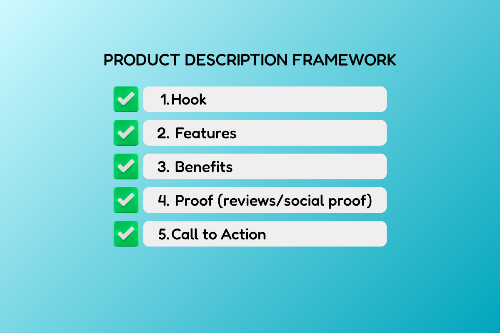
Use this simple framework across products:
1. Hook – 1–2 sentences naming the problem or goal.
2. Features – What it is and what it includes.
3. Benefits – Why those features matter to the buyer.
4. Proof – Reviews, data, guarantees, or certifications.
5. CTA – A clear nudge to buy or add to cart.
This structure makes writing faster and ensures every description supports conversions.
Standardize Length and Format by Category
Define a default format per product category, for example:
- Apparel: 80–120 word intro + 4–6 bullet points
- Electronics: 120–180 word intro + 6–8 bullet points + tech specs table
- Home goods: 80–150 words + 3–5 bullets + care instructions
When you know the shape of the description before you start, writing is much quicker.
Step 2: Batch Your Product Research for Efficiency
Collect Specs, Benefits, and Use Cases in One Pass
Instead of researching each product as you write:
- Take one session to gather specs for a whole category.
- Talk to sales or support for typical customer questions.
- Note real use cases (“ideal for busy parents,” “perfect for home offices”).
You’re creating raw material you can reuse across multiple descriptions.
Build a Centralized Product Info Sheet
Use a spreadsheet with columns like:
- Product name
- Key specs
- Top 3 benefits
- Main use cases
- Primary keyword
- Links to images / manuals / reviews
Now you can write product descriptions straight from the sheet without hunting for details.
Step 3: Use Customer Language to Maintain Quality
Mine Reviews and Support Tickets for Phrases
Customer language is gold for conversion-focused copy:
- Pull phrases from your own reviews or competitors’ reviews.
- Scan support tickets and chat logs for common complaints and questions.
- Copy exact wording into your product info sheet.
This keeps your copy grounded in real problems and desires.
Turn Pain Points Into Benefit-Driven Copy
For each pain point, write a benefit:
- Pain: “I hate how quickly cheap chargers break.”
- Benefit copy: “Built with reinforced cables so you’re not replacing your charger every few months.”
This is how you improve eCommerce product descriptions at scale without sounding generic.
Step 4: Draft Faster Using Templates and Prompts
Plug Product Details Into a Description Template
Create a template like:
- One-line hook: [who] + [problem] + [outcome]
- Short paragraph: summarize main benefit + key features
- Bullets:
- [Feature] – [Benefit]
- [Feature] – [Benefit]
- Proof line: [review snippet / guarantee]
- CTA: “Add to cart to [main outcome].”
Copy the template, paste in the product’s details from your sheet, and tweak.
Leverage AI to Generate First Drafts Quickly
Use AI to:
- Turn your bullet points into a full paragraph
- Rewrite for different audiences (“busy parents,” “DIY enthusiasts”)
- Adjust length (short for collection pages, longer for main product pages)
You stay in control of quality, but drafting time drops dramatically.
Step 5: Optimize Product Descriptions for SEO Without Slowing Down
Insert Primary and Secondary Keywords Naturally
For each product:
- Use the primary keyword in the first 1–2 sentences.
- Add secondary keywords once each in body copy or bullets.
- Avoid repeating keywords unnecessarily—no keyword stuffing.
Example: “This insulated travel mug helps you write product descriptions in a café without worrying your coffee will go cold.” (Natural, not forced.)
Use Scannable Elements: Bullets, Subheadings, Formatting
Most shoppers skim. Help them:
- Use bullets for features and benefits
- Bold key phrases like sizes, materials, and unique selling points
- Add mini-subheadings (“Why you’ll love it,” “Perfect for,” “What’s included”)
This also helps search engines understand your high-converting product descriptions.
Step 6: Create a Fast but Reliable Editing Checklist
Quick Quality Checks: Clarity, Accuracy, and Tone
Before publishing, run a 2–3 minute check:
- Does it clearly say what the product is and who it’s for?
- Are specs accurate and up to date?
- Are there any confusing or vague claims?
- Does it sound like a real person talking to a customer?
Fixing these upfront avoids returns and complaints later.
Consistency Checks: Brand Voice and Formatting
Scan for:
- Consistent units (cm vs inches, ml vs oz)
- Same tone across a category (not playful on one page and ultra-formal on another)
- Similar length and structure for similar products
Consistency builds trust and speeds up future editing.
Step 7: Systematize and Scale Your Workflow
Set Up Batch Writing and Review Cycles
Work in batches:
- Day 1: Research and fill in the product info sheet
- Day 2: Draft 10–20 descriptions using templates and AI
- Day 3: Edit and finalize, then upload
Batching reduces context-switching and helps you write product descriptions quickly without losing quality.
Build a Swipe File of High-Performing Descriptions
Save examples of:
- Your best-converting pages
- Competitors’ product pages you admire
- Strong hooks, bullets, and CTAs
Use this swipe file for inspiration and training new team members.
Common Mistakes & Fixes
Mistake 1: Writing Too Fast and Sacrificing Accuracy
Rushing leads to wrong sizes, missing details, or misleading claims.
How to Fix: Fact-Check With a Simple Verification Pass
Compare each description with:
- Product info sheet
- Supplier data or spec sheet
- Any legal or safety requirements
One quick pass prevents costly returns.
Mistake 2: Generic, Copy-Paste Product Descriptions
Copying manufacturer text or reusing the same sentences kills conversions.
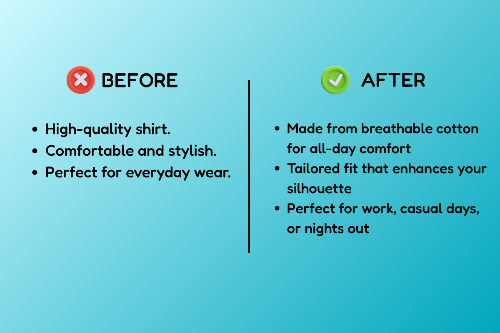
How to Fix: Add Specific Use Cases and Unique Angles
For each product, add:
- 1–2 specific situations where it shines
- A unique benefit vs similar items (“lighter,” “quieter,” “kid-safe,” “travel-friendly”)
Small tweaks make eCommerce product descriptions feel tailored, not templated.
Mistake 3: Keyword Stuffing That Hurts Readability
Overloading pages with keywords makes them hard to read and can hurt rankings.
How to Fix: Prioritize Natural, Customer-Friendly Language
Write for humans first:
- Draft the copy without thinking about keywords
- Insert your primary keyword once or twice where it fits
- Read it aloud—if it sounds weird, rewrite
SEO-friendly product descriptions are still plain, clear English.
Mistake 4: Ignoring Mobile and Skim Readers
Long, dense blocks of text lose shoppers on phones.
How to Fix: Use Short Paragraphs and Bullet Points
Aim for:
- 1–3 sentence paragraphs
- Clear section breaks
- Bullets for features, benefits, and what’s included
Check your pages on a phone before you sign off.
Mistake 5: No Process for Measuring Performance
If you don’t measure, you can’t improve.
How to Fix: Track Conversions and Iterate on Winners
Use your analytics to monitor:
- Product page conversion rate
- Add-to-cart rate
- Time on page
Test variations of hooks, bullets, and CTAs. Add winners to your swipe file and template.
Summary & Key Takeaways
Recap: How to Write Product Descriptions Faster Without Losing Quality
You’ve seen how to:
- Build a reusable framework so you can write product descriptions quickly
- Batch research and centralize product info
- Use customer language for more persuasive, high-converting product descriptions
- Add SEO and structure without slowing down
- Turn the process into a scalable workflow for your team
The Core Principles to Remember
- System beats speed: templates, checklists, and batches do the heavy lifting.
- Customers first: real language, real benefits, real proof.
- Measure and improve: keep what works, upgrade what doesn’t.
Call to Action (Apply, Share, or Try)
Apply This Workflow to Your Next 10 Product Descriptions
Pick one category, fill in a product info sheet, use the framework above, and time yourself. You’ll quickly see how an efficient workflow for product description copywriting changes the game.
Share These Techniques With Your Team or Clients
If you have a team or agency partners, share this process and turn it into a simple SOP. Consistency will save you hours every month.
Next Steps: Build Your Own Product Description Template
Create one master template based on your best-performing pages, then refine it over time. When you’re ready, connect it with AI prompts and your SEO list to improve eCommerce product descriptions at scale.
Have questions or want a sample template for your niche? Drop them in the comments or reach out—and start upgrading your product pages today.
How Prosperna Helps SMBs Write Product Descriptions Faster
If you’re an SMB owner, you’re probably wearing multiple hats—operations, customer service, marketing, and sometimes even content writing.
That’s exactly why Prosperna was built: to make eCommerce simpler and more manageable for small and medium businesses.
Prosperna gives you an all-in-one platform to run your online store, but it doesn’t stop at listings and payments. When it’s time to write product descriptions, Prosperna helps you move faster without sacrificing quality.
Max AI Product Description Generator
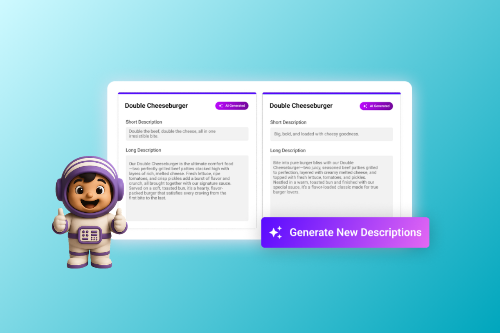
Inside Prosperna, you get access to Max AI Product Description Generator, your built-in writing partner for ecommerce product descriptions.
Max AI helps you:
- Generate compelling, on-brand product descriptions instantly—tailored for small business shoppers and local SEO.
- Turn raw product details (features, specs, materials) into benefit-driven, conversion-focused copy.
- Keep your brand voice consistent across hundreds of product pages, even if different people are helping with product copywriting.
- Produce SEO-friendly product descriptions by naturally including relevant keywords and clear structure.
Instead of starting from a blank page every time, you can:
- Input your product details,
- Let Max AI generate a first draft, and
- Do a quick edit pass using the checklist from this guide.
This gives you an efficient workflow for product description copywriting that saves hours, especially when you’re uploading or updating large catalogs.
Why This Matters for Growing SMBs
As your business grows, so does your product list. Without a system, product description writing becomes a bottleneck.
With Prosperna and Max AI, you can:
- Write product descriptions quickly without losing quality,
- Improve ecommerce product descriptions at scale, and
- Free up more time to focus on sales, operations, and customer relationships.
Prosperna becomes not just your store platform, but a partner in scaling your content and conversions.
Try a Faster Way to Write Product Descriptions
If you’re tired of staring at blank product pages or copying generic manufacturer text, it’s a good sign you’ve outgrown manual-only product description writing.
With Prosperna and Max AI, you can:
- Standardize your product description writing process,
- Generate on-brand drafts in seconds, and
- Quickly refine them into high-converting product descriptions that match your brand and speak to real customers.
If you’re ready to speed up your product copy without sacrificing quality, explore how Prosperna and Max AI can fit into your daily workflow.
FAQ: Writing Product Descriptions Faster Without Losing Quality
1. How long should a product description be for SMB online stores?
For most products, 80–150 words plus bullet points is enough; more complex items may need 150–250 words, as long as the copy is clear and focused on benefits.
2. Can I still rank on search if I use AI to write product descriptions?
Yes—as long as the content is original, accurate, and genuinely helpful, using AI for drafting and a quick human edit can still produce SEO-friendly product descriptions.
3. How do I keep product descriptions consistent if multiple people are writing them?
Use a shared style guide, a standard template, and tools like Max AI so everyone follows the same structure, tone, and formatting.
4. What’s the biggest mistake SMBs make when trying to write faster?
Rushing into generic, copy-paste text is the biggest mistake; you should still reflect real customer needs and benefits even when you speed up.
5. How exactly does Prosperna’s Max AI help me save time?
Max AI lets you generate compelling, on-brand product descriptions instantly—tailored for small business shoppers and local SEO—so you spend minutes polishing instead of hours drafting.
Final Thoughts
Writing product descriptions doesn’t have to be the task that slows down your entire eCommerce strategy.
When you:
- Use a clear framework for every product,
- Batch your research and planning,
- Focus on real customer language and benefits, and
- Support your process with tools like Prosperna’s Max AI Product Description Generator,
you can write product descriptions quickly without losing quality and keep your store moving forward.
For SMBs transitioning to online selling, this combination of smart process + the right tools is what turns product pages from plain catalogs into conversion-focused sales assets.
Prosperna, Your Partner to eCommerce Success
Prosperna is an all-in-one AI-powered eCommerce platform for SMBs, entrepreneurs, and content creators. Our mission is to empower 1 million businesses with simple, affordable tools powered by AI.
We’re so passionate about helping small businesses succeed that we offer a FREE account forever.
👉 Create your FREE-forever Prosperna account.
Comments
Loading comments...